
The Science Behind Thermal Modification: How Heat Transforms Timber
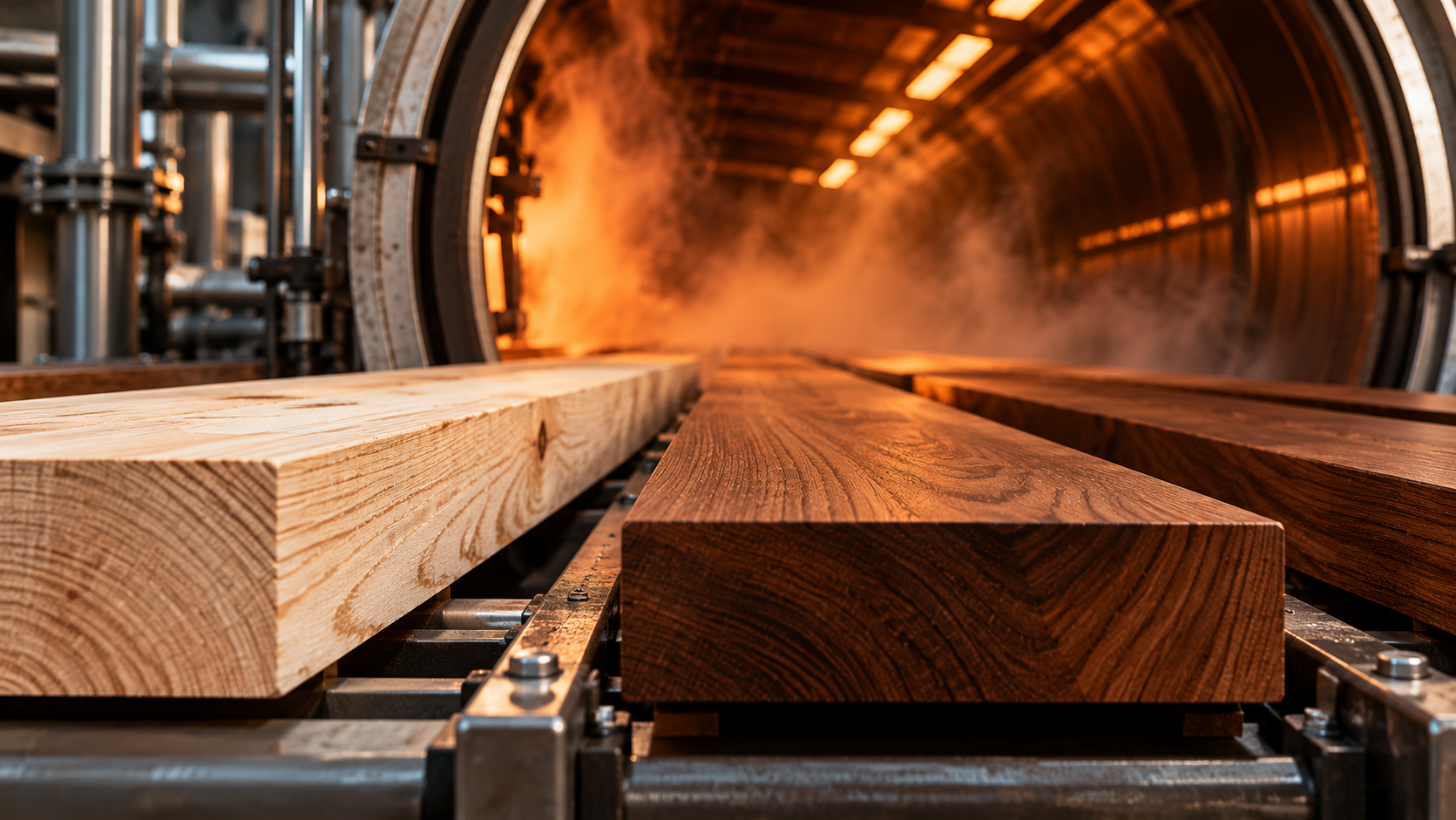
Wood has shaped architecture for centuries. Its natural warmth, distinctive grain and connection to the environment make it one of the most enduring materials in architectural design.
Contents
Yet conventional timber presents challenges. Changes in moisture, temperature and environmental exposure can cause swelling, shrinkage, distortion and biological deterioration.
What if we could improve timber’s natural performance without compromising its character?
Through carefully controlled heat treatment, natural wood undergoes a remarkable transformation. Its internal chemistry changes, its dimensional stability improves and its resistance to biological decay increases.
The result is a high-performance architectural timber suitable for a wide range of contemporary interior and exterior applications.
At AXIS™ Timber Surfaces, we introduce Australian architects, designers and builders to advanced thermally modified timber manufactured by Tantimber®, combining natural material beauty with innovative timber technology.
Understanding the science behind this transformation reveals why thermally modified timber is becoming an increasingly compelling material for modern architecture.
1.What Is Thermally Modified Timber?
Thermally modified timber is natural wood that has undergone a controlled heat-treatment process designed to improve its physical and biological performance.
Unlike conventional preservative treatments, which may introduce chemicals into the wood, thermal modification primarily relies on three elements:
Depending on the timber species and treatment specification, temperatures typically reach approximately 180°C to 220°C.
Throughout the process, temperature, moisture and oxygen levels are carefully controlled.
These conditions initiate changes within the wood’s chemical structure, producing a material that behaves differently from untreated timber.
The result is timber with several important characteristics:
- Improved dimensional stability.
- Reduced moisture absorption.
- Increased resistance to certain wood-decaying fungi.
- Richer, darker and more consistent colour throughout the treated section.
- No conventional chemical preservatives added during thermal modification.
These properties make thermally modified timber particularly attractive for architectural applications where material performance and natural aesthetics are equally important.
However, thermal modification does not make timber completely waterproof, maintenance-free or immune to deterioration. Appropriate detailing, installation and product selection remain essential.
2.The Science: What Happens Inside the Wood?
To understand thermal modification, we first need to understand what timber is made of.
Wood consists primarily of three structural components:
Together, these natural polymers form the structure of wood and influence its mechanical strength, moisture behaviour and durability.
When timber undergoes thermal modification, heat causes chemical changes within these components.
Hemicellulose: Reducing Moisture Sensitivity
Hemicellulose is one of the most moisture-sensitive components of wood.
During thermal modification, portions of the hemicellulose break down through heat-induced chemical reactions.
This reduces the number of sites within the wood that readily interact with moisture.
Consequently, thermally modified timber generally absorbs less moisture from the surrounding environment than untreated timber of the same species.
This reduction in moisture sensitivity is one of the principal reasons thermally modified timber exhibits improved dimensional stability.
Cellulose: Preserving the Structural Framework
Cellulose forms much of the structural framework of timber.
Under controlled treatment conditions, a substantial portion of the cellulose structure remains intact, although some degradation can occur, particularly at higher treatment temperatures.
This is why thermal modification must be carefully managed.
Excessive treatment can reduce mechanical properties, including bending strength and impact resistance.
For architects and builders, this distinction is important: thermally modified timber should not automatically be considered suitable for structural applications unless the specific product has been tested and approved for that purpose.
Lignin: Contributing to Colour and Stability
Lignin helps bind the wood’s structural components together.
During heat treatment, lignin undergoes chemical changes that contribute to the altered physical properties and darker appearance of thermally modified timber.
These transformations help create the characteristic warm brown tones associated with thermally modified ash, pine and other timber species.
3.How Does the Thermal Modification Process Work?
Industrial thermal modification is performed in specialised treatment chambers under precisely controlled conditions.
Although individual manufacturers may use proprietary technologies and processing parameters, the process generally involves three principal stages.
Stage One: Heating and Drying
Timber is placed inside a controlled treatment chamber.
The temperature gradually increases while moisture is removed from the wood.
Steam may be introduced to help regulate the treatment environment and protect the timber from excessive thermal degradation.
During this stage, the timber is prepared for the higher temperatures required for modification.
Stage Two: Thermal Modification
The chamber temperature is raised to the specified treatment level, often exceeding 200°C for higher-intensity treatments.
The timber is maintained at the target temperature for a controlled period.
This is the critical transformation stage.
Heat changes the chemical composition of the wood, reducing its hygroscopicity—its tendency to absorb moisture from the surrounding air.
These changes improve dimensional stability and can increase resistance to biological decay.
Different treatment temperatures and durations produce different performance characteristics.
Stage Three: Controlled Cooling and Conditioning
Following thermal modification, the timber is gradually cooled.
Moisture is carefully reintroduced or allowed to equilibrate to achieve an appropriate final moisture content.
This conditioning stage prepares the timber for subsequent machining, profiling and manufacturing.
Once completed, the modified timber can be processed into architectural products such as exterior cladding, façade profiles, architectural screening, decking boards, interior wall and ceiling linings, and decorative timber surfaces.
The outcome is a natural material whose properties have been altered through controlled thermal technology.
4.Why Does Thermally Modified Timber Perform Better?
The architectural advantages of thermally modified timber are closely connected to the changes occurring within its cellular structure.
Greater Dimensional Stability
Natural timber expands and contracts as environmental moisture levels change.
This movement can affect joints, alignment, surface finishes and the long-term appearance of architectural installations.
Because thermally modified timber generally absorbs less moisture, its swelling and shrinkage are reduced.
For architectural cladding and interior linings, improved dimensional stability can help maintain cleaner joints and more consistent visual alignment.
This is particularly valuable in design applications where precise detailing and refined finishes are essential.
Improved Biological Durability
Wood-decaying fungi require suitable moisture conditions to grow.
Thermal modification changes the wood’s chemical composition and moisture behaviour, increasing resistance to certain decay organisms.
The level of improvement depends on the timber species, treatment intensity and intended exposure conditions.
Thermally modified timber is not automatically resistant to termites, marine borers or every form of biological deterioration.
Australian designers should verify product-specific durability information and suitability for the relevant application.
Reduced Moisture Absorption
Thermally modified timber typically reaches a lower equilibrium moisture content than untreated timber under comparable environmental conditions.
This contributes to its dimensional stability.
For designers, this can translate into greater confidence when specifying timber for carefully detailed architectural surfaces.
Natural Colour Transformation
One of the most visually distinctive outcomes of thermal modification is the transformation of timber colour.
Depending on the species and treatment conditions, pale natural wood can develop rich caramel, chocolate and deep brown tones.
Unlike a conventional surface stain, thermal modification changes the colour through the treated timber section.
This creates opportunities for architectural applications where authentic material character is central to the design.
However, thermal modification does not prevent natural weathering.
When exposed to sunlight and the elements, uncoated timber can gradually develop a silver-grey patina.
Appropriate UV-protective finishes can help retain the original brown appearance where desired.
5.Thermally Modified Timber in Australian Architecture
Australia presents a diverse range of architectural environments.
From coastal residences and contemporary urban developments to regional homes and commercial spaces, timber must often respond to changing environmental conditions.
Thermally modified timber offers architects an additional material option for projects where natural aesthetics and improved dimensional stability are priorities.
Exterior Timber Cladding
Architectural timber cladding creates depth, texture and visual warmth.
Thermally modified timber can be used to develop refined exterior façades with horizontal or vertical profiles.
Its reduced moisture movement makes it particularly appealing for precisely detailed façade systems.
Appropriate ventilation, drainage, fixing methods and compliance with relevant building requirements remain essential. Explore timber cladding.
Architectural Screens and Feature Elements
Timber screens introduce rhythm, privacy and natural texture to contemporary architecture.
Thermally modified timber can provide a distinctive material palette for decorative screening and architectural features.
Designers should consider fixing arrangements, exposure conditions and product-specific performance when developing these elements. Explore battens and screening.
Interior Wall and Ceiling Linings
Interior applications offer opportunities to explore the tactile qualities of natural timber.
Thermally modified timber can introduce rich colour and texture into residential, hospitality and commercial interiors.
Its natural appearance complements contemporary Australian design approaches that emphasise material authenticity, restrained detailing and connections to nature. Explore ceilings and soffits.
Timber Decking
Selected thermally modified timber products are suitable for decking applications.
Their reduced moisture sensitivity and improved dimensional stability can offer advantages in outdoor environments.
However, decking performance depends on the specific timber species, treatment process, profile, installation method and exposure conditions.
Slip resistance, structural support, durability and relevant compliance requirements must be considered. Explore timber decking.
6.Sustainability: A Natural Approach to Material Performance
Contemporary architecture increasingly considers more than appearance alone.
Material selection involves questions of durability, environmental impact, resource efficiency, maintenance and long-term performance.
Timber offers a distinctive combination of natural texture, warmth and design versatility.
Thermal modification builds upon these characteristics by improving selected performance properties without adding conventional chemical preservatives during treatment.
A Material Connected to Nature
Every timber board contains natural variations in grain, tone and texture.
These characteristics create a visual richness that manufactured imitations cannot fully replicate.
For architects and interior designers, this authenticity is often fundamental to the material concept.
Responsible Material Selection
Timber can form part of environmentally responsible construction when sourced from appropriately managed forests and supported by credible supply-chain documentation.
Forest certification systems such as FSC® and PEFC provide frameworks for responsible forest management and chain-of-custody verification.
Environmental Product Declarations (EPDs) can provide independently verified information about the environmental impacts of specific products.
Certification and environmental performance claims should always be checked against the exact product, manufacturer and applicable certification scope.
Longevity Through Appropriate Design
Material longevity depends on more than manufacturing technology.
Correct specification, installation, ventilation, drainage and maintenance contribute significantly to long-term performance.
By combining suitable thermally modified timber products with thoughtful architectural detailing, designers can create natural timber surfaces intended to perform over many years.
7.Tantimber®: Advanced Thermal Modification Technology
At AXIS™ Timber Surfaces, our architectural timber offering is developed around products manufactured by Tantimber®, a specialist in thermally modified timber.
Tantimber applies advanced thermal modification technology to selected timber species, producing materials intended for architectural and design applications.
The manufacturing process enhances natural timber characteristics through controlled thermal treatment.
This approach supports the development of architectural products that combine distinctive natural appearance with improved dimensional stability and durability characteristics.
Thermally Modified Ash
Thermally modified ash is recognised for its expressive grain, rich brown colour and refined architectural appearance.
Its distinctive texture makes it particularly appealing for contemporary design applications where material character is a defining feature. View the Structural Grain Collection (Ash).
Thermally Modified Ayous
Ayous offers a relatively lightweight timber option with a fine, understated grain.
After thermal modification, its appearance becomes warmer and darker, creating opportunities for architectural linings and selected cladding applications. View the Contemporary Collection (Ayous).
Thermally Modified Pine
Thermally modified pine provides another option for architectural applications.
The thermal treatment process improves its dimensional stability and modifies its natural appearance.
Performance and suitability vary according to the specific product and treatment classification. View the Nordic Collection (Pine).
Through AXIS™, Australian architects, designers and builders can explore Tantimber’s thermally modified timber range for contemporary architectural projects.
8.What Architects Should Consider Before Specifying Thermally Modified Timber
Although thermal modification improves several important timber properties, successful architectural specification requires a complete understanding of the selected product.
Select the Appropriate Timber Species
Different species have different densities, grain structures, mechanical properties and aesthetic characteristics.
The choice should reflect both the design concept and the intended application.
Confirm the Treatment Classification
Thermal modification processes can be tailored to achieve different performance outcomes.
The treatment classification and manufacturer specifications should be reviewed before selecting timber for a particular exposure environment.
Consider Fixings and Installation
Thermally modified timber can be more brittle than untreated timber.
Correct fixing methods, edge distances and installation procedures are therefore important.
Pre-drilling may be recommended for certain profiles and applications.
Allow for Natural Weathering
Exterior timber exposed to UV radiation will naturally change appearance over time.
Designers should decide whether the desired aesthetic is the original warm brown tone or the gradual development of a silver-grey patina.
Review Project Compliance
Architectural timber must be assessed against relevant Australian building requirements.
Depending on the application, considerations may include fire performance, bushfire exposure, structural requirements, durability, moisture management and installation specifications.
Product-specific technical documentation should be reviewed before final specification.
9.From Natural Material to Architectural Innovation
Thermal modification represents an important development in timber technology.
Rather than replacing the natural qualities of wood, the process enhances selected performance characteristics through controlled heat treatment.
The result is a material that retains its authentic grain and texture while offering improved dimensional stability and resistance to certain forms of biological deterioration.
For architects, the significance extends beyond technical performance.
Thermally modified timber provides opportunities to create buildings that feel connected to their environment.
It supports architectural expressions that celebrate natural materials, refined detailing and thoughtful design.
From contemporary residential façades to carefully considered interior surfaces, thermally modified timber brings together material science and architectural creativity.
10.Discover Thermally Modified Timber With AXIS™
At AXIS™ Timber Surfaces, we believe exceptional architecture begins with thoughtful material selection.
As an Australian distributor of Tantimber® products, AXIS™ connects architects, interior designers, builders and developers with a curated range of high-performance thermally modified timber surfaces.
Whether you are developing a contemporary residential façade, designing an architectural interior or exploring timber for an upcoming project, our team can assist with product selection and specification enquiries.
Frequently Asked Questions
What is thermally modified timber?
Thermally modified timber is natural wood treated at elevated temperatures under controlled conditions. The process changes the wood’s chemical structure, generally reducing moisture absorption and improving dimensional stability and resistance to certain decay organisms.
Is thermally modified timber suitable for Australian climates?
Selected thermally modified timber products can be suitable for Australian architectural applications. Suitability depends on the timber species, treatment classification, exposure conditions, installation details and relevant building requirements.
Does thermally modified timber contain chemicals?
The thermal modification process does not require conventional chemical preservatives. It primarily uses controlled heat and steam. However, subsequent coatings, adhesives or other manufacturing treatments may introduce additional substances, depending on the finished product.
Is thermally modified timber waterproof?
No. Thermal modification reduces moisture absorption but does not make timber waterproof. Proper drainage, ventilation and installation remain important.
Does thermally modified timber require maintenance?
Maintenance requirements depend on the application, environmental exposure and desired appearance. Exterior timber may naturally weather to a silver-grey colour unless an appropriate protective finish is applied and maintained.
Can thermally modified timber be used for exterior cladding?
Yes, selected thermally modified timber products are designed for exterior cladding. Designers must confirm product suitability, installation requirements and applicable building regulations.
Is thermally modified timber stronger than untreated timber?
Not necessarily. Thermal modification can improve dimensional stability and biological durability, but some mechanical properties may decrease. Structural applications require specific engineering verification.
Where can I buy thermally modified timber in Australia?
AXIS™ Timber Surfaces supplies architectural thermally modified timber products manufactured by Tantimber®. Architects, designers and builders can explore the collection, request samples and enquire about project pricing through AXIS™.
Conclusion: Nature Transformed by Science
The transformation of timber through heat demonstrates how material science can expand the possibilities of natural materials.
By carefully modifying wood’s internal chemistry, thermal technology creates timber with improved dimensional stability, reduced moisture sensitivity and enhanced resistance to certain forms of decay.
For contemporary Australian architecture, these properties offer new opportunities to integrate natural timber into thoughtfully designed spaces.
Explore the collection. Experience the material. Specify with confidence.